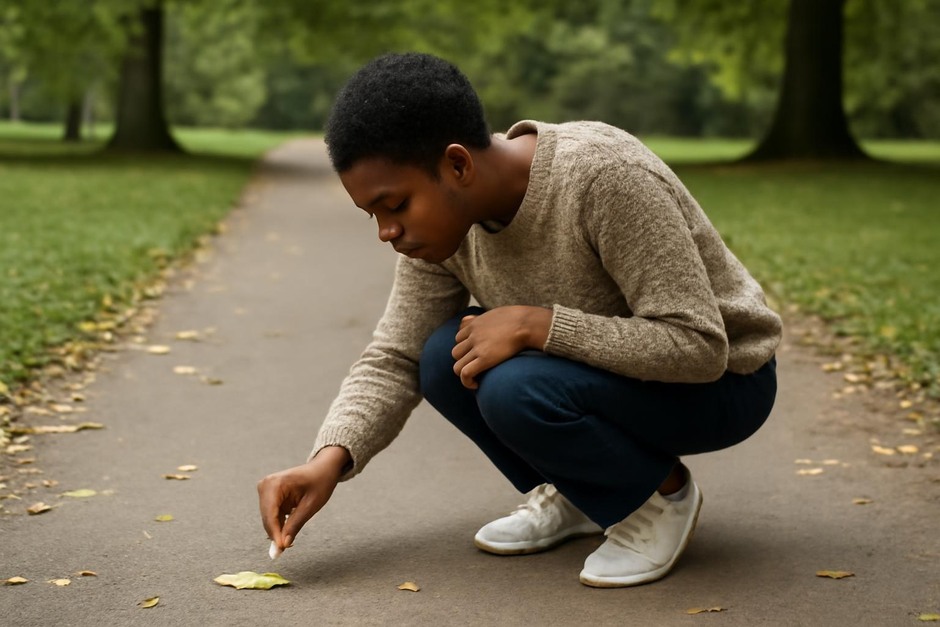
Five Short Experiments to Sharpen Everyday Observation
Noticing is a skill you can practice in short bursts. These five small experiments build on one another: each is easy to fit into a coffee break or a short walk, and together they form a practical routine for becoming more observant without needing special tools or a big time commitment.
How to use these experiments
Do them in order on a single outing or spread them across days. Each experiment includes a simple prompt and an example. After each try, take 30–60 seconds to jot one line in your phone or a pocket notebook about what you observed. That tiny record helps turn experience into lasting skill.
Experiment 1 — One Sense, Five Minutes
Principle: Narrowing focus makes subtle detail easier to see.
Prompt: Choose one sense (sight, sound, or smell). Spend five minutes with only that sense active. If you choose sight, look without other tasks; if sound, close your eyes and listen; if smell, pause near likely sources like a bakery or a lawn.
Example: Walk slowly for five minutes solely noticing colors. Count how many different shades of green you see and name the three you remember afterward. You may notice a new hue in a hedge or a faded paint stripe you never paid attention to before.
Experiment 2 — Timed Repetition (Same Route, Different Times)
Principle: Patterns reveal themselves with repetition and contrast.
Prompt: Pick a short route you already know. Walk it twice at two different times of day (morning/evening, or before/after lunch). Each walk should be 8–10 minutes. Note two differences and two consistent features.
Example: On the morning pass you hear a delivery truck and see dew on benches; in the evening you notice more foot traffic and longer shadows. The lamppost stays the same; the small sapling by the gate is still leaning the same direction. Noting both change and constancy trains you to spot useful signals rather than random noise.
Experiment 3 — Inventory Counting
Principle: Making a short, specific list anchors attention and improves memory for particulars.
Prompt: Choose one category—birds, types of vehicles, benches, or lamp posts. Walk a chosen stretch for 10–15 minutes and count how many of that item you see. Try to note any unusual examples.
Example: Count benches on a three-block walk. You find seven benches: five standard, one with a missing slat, and one newer bench with a metal backrest. That single unusual bench becomes an anchor for remembering the route later.
Experiment 4 — Quick Sketch, One-Minute Memory
Principle: Recalling and translating what you saw into another form strengthens encoding.
Prompt: Stop after a short walk and, without looking back, draw a quick map or sketch of one small scene for one minute. Include three details you remember vividly.
Example: Sketch the front of a corner shop: an awning, a sandwich board, the street tree with a low branch. Even a crude drawing forces you to prioritize which details mattered most and reveals gaps to notice next time.
Experiment 5 — Micro-Map with a Sensory Note
Principle: Combining spatial memory with a sensory tag creates stronger recall and makes the environment more meaningful.
Prompt: On a 10–15 minute walk, mentally map a 200–300 meter area. On your mental map, place three sensory notes: a scent (bread, diesel), a sound (fountain, distant construction), and a visual oddity (mismatched brick, bright door). Write these three on your one-line record after the walk.
Example: You map the block and note: “Corner bakery — warm bread smell; underpass — distant hum; blue door with chipped brass knob.” Next time you pass, those three cues will help you navigate and compare change over time.
Putting the experiments into routine
Start with one experiment per day for a week. Swap the sense or the category each time so you don’t get mechanically habitual. After two weeks, revisit the same route and see which details you remember without checking your notes. The goal isn’t photographic memory; it’s a reliably richer experience of ordinary places.
Small, varied practices like these sharpen attention and build habits that make everyday life more interesting. The experiments are short by design: their value comes from repetition and reflection, not endurance. Keep them playful, and let your curiosity guide which detail becomes the focus next time.